| Artefact ID | 510 |
| TM ID | TM 64589 |
| Findspot (DEChriM ID) | - () | Class | Textual |
| Material | Papyrus |
| Writing medium | Sheet/roll |
| Text content | Subliterary |
| Language | Greek |
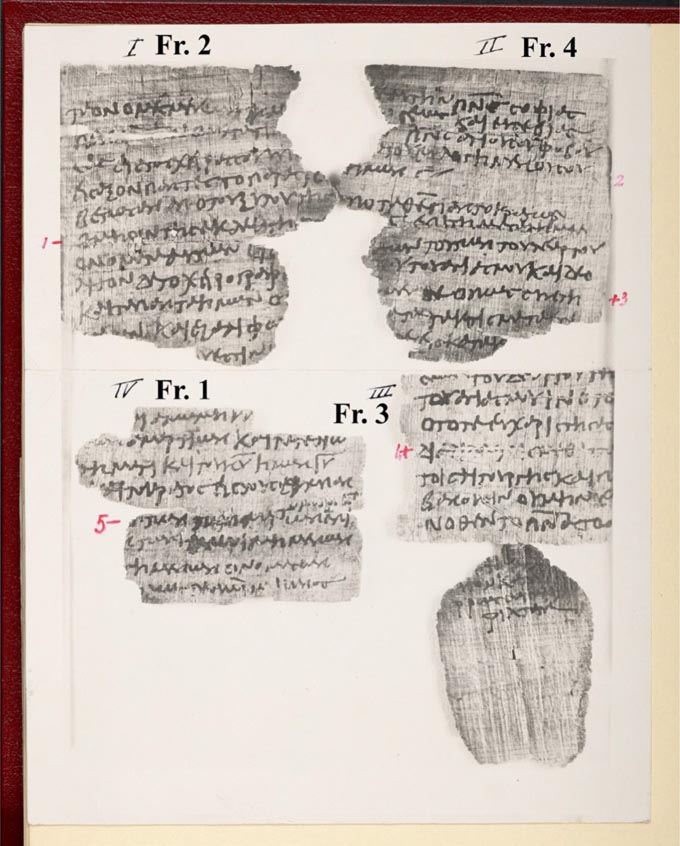
| Description | Milan Euchologion. Four fragmentary papyrus sheets preserving a sequence of Eucharistic prayers in Greek. Originally published by Ghedini (1933), the fragments were subsequently lost, probably during the Second World War, and their present whereabouts are unknown. A photograph of their written sides, sent by Ghedini to Harold Idris Bell in 1933 and preserved among Bell’s papers in the British Library (Add MS 59525, fol. 128v), has permitted a new arrangement, edition and interpretation of the fragments. According to the reconstruction of Mihálykó and Chase (2024), the four fragments preserve a Eucharistic sequence consisting of: (1) the end of an anaphora, including a request for the fruits of communion and an intercession for the deceased (frs. 1–2); (2) a prayer of fraction, containing references to the Last Supper and a request for the sending of the Holy Spirit upon the congregation (fr. 3–fr. 4, l. 5); and (3) a prayer of thanksgiving after communion (fr. 4, ll. 6–12). The arrangement is partly reconstructed on philological and liturgical grounds because of the extensive loss of text. The preserved fragments measure approximately 6.5 × 8 cm (fr. 1), 8 × 8 cm (fr. 2), 5.5 × 8 cm (fr. 3), and 8 × 7.7 cm (fr. 4). Writing runs across the fibres and only one side was inscribed. Corresponding folds and breaks indicate that the sheets were kept and folded together and probably formed a series used to copy a sequence of prayers. The original sheets are estimated to have been approximately 12–15 cm wide; their original height cannot be established. The text contains regular nomina sacra and only limited devices for marking textual divisions. The script is a practised documentary cursive. Although the copying contains several errors and corrections, the generally good orthography suggests a trained scribe. |
| Selection criteria | Subliterary genre (Liturgical), Nomina sacra |
| Date from | 350 |
| Date to | 399 |
| Dating criteria | Palaeography. Ghedini dated the hand to the end of the fourth century, or less probably the beginning of the fifth. Mihálykó and Chase compare the script with dated documentary hands, especially P.Cair.Goodsp. 15 (362), P.Lips. I 62 (385) and P.Lips. I 37 (389), and consequently date the manuscript to the second half of the fourth century. |
| Absolute/relative date | Relative date |
| Archaeological context | Provenance unknown. The four fragments formerly belonged to the papyrological collection of the Università Cattolica del Sacro Cuore, Milan, but are no longer present in its inventory and were probably lost during or around the Second World War. Their findspot and circumstances of acquisition are unknown. The closest palaeographical parallels cited by Mihálykó and Chase derive from Hermopolis, and certain liturgical characteristics might also be compatible with a Hermopolite provenance; the authors stress, however, that this hypothesis remains highly speculative and cannot presently be verified. |
| Accession number | Milan, Università Cattolica, P.Med. number unknown (original papyri lost; see VanHaelst 1976: 275). Photographic documentation: London, British Library, Add MS 59525, fol. 128v. |


ARTEFACT IDENTIFIERS
 Json data